Yugoslav People's Army (JNA) was the common armed force of all nations and nationalities, working people and citizens of the SFRY (Socialist Federal Republic of Yugoslavia). It was part of the unified armed forces of the SFRY. Together with the Territorial Defense of the SFRY, its task was to: protect the independence, integrity, territorial completeness and constitutionally established social order of the country. Through its organization, armament, high level of equipment, training and firm moral-political unity, it constituted the strike force of the SFRY armed forces.  It was intended and It was intended and  equipped for conducting armed combat across the entire Yugoslav theater of war, covering the main strategic and operational directions on land, sea and in the air, against the main enemy formations. It was primarily trained and intended for combined and frontal forms of armed combat. For this reason it was specially equipped and trained for anti-armor and anti-aircraft combat against the main formations of armored-mechanized, aviation and naval assault forces of potential aggressors. Through its peacetime existence, the Yugoslav People's Army was an important factor of internal stability and a key element of deterrence against aggression on the SFRY. equipped for conducting armed combat across the entire Yugoslav theater of war, covering the main strategic and operational directions on land, sea and in the air, against the main enemy formations. It was primarily trained and intended for combined and frontal forms of armed combat. For this reason it was specially equipped and trained for anti-armor and anti-aircraft combat against the main formations of armored-mechanized, aviation and naval assault forces of potential aggressors. Through its peacetime existence, the Yugoslav People's Army was an important factor of internal stability and a key element of deterrence against aggression on the SFRY.
 The Yugoslav People's Army was organized into branches, corps and services, which in turn comprised corresponding commands, units and institutions. The branches were: the Ground Army (KoV), the Air Force and Anti-Aircraft Defense The Yugoslav People's Army was organized into branches, corps and services, which in turn comprised corresponding commands, units and institutions. The branches were: the Ground Army (KoV), the Air Force and Anti-Aircraft Defense (RV i PVO) and the Navy (RM). The corps were: infantry, armored units, artillery, anti-aircraft artillery-rocket units, border units, engineering, atomic-biological-chemical defense (ABHO), signals, maritime, aviation, electronic reconnaissance and electronic countermeasures (EI i PED), and aerial observation, reporting and guidance (VOJIN). The services were: ground technical service, aviation technical, naval technical, supply, medical, veterinary, transportation, construction, legal, geodetic, financial, administrative, information and music services. The corps and services were unified (for all three branches), although some belonged more to a specific branch by the nature of their organization and purpose (e.g., armored units in the Ground Army). (RV i PVO) and the Navy (RM). The corps were: infantry, armored units, artillery, anti-aircraft artillery-rocket units, border units, engineering, atomic-biological-chemical defense (ABHO), signals, maritime, aviation, electronic reconnaissance and electronic countermeasures (EI i PED), and aerial observation, reporting and guidance (VOJIN). The services were: ground technical service, aviation technical, naval technical, supply, medical, veterinary, transportation, construction, legal, geodetic, financial, administrative, information and music services. The corps and services were unified (for all three branches), although some belonged more to a specific branch by the nature of their organization and purpose (e.g., armored units in the Ground Army).
 Military obligation in the Yugoslav People's Army was universal. It consisted of draft duty, mandatory military service, and service in the reserve corps. In socialist Yugoslavia there was a system of all-people's defense and social self-protection, so the Yugoslav People's Army was "the common armed force of all nations and nationalities and all working people and citizens of the SFRY". Every citizen "who participates with weapon in hand in resistance against an aggressor" was considered a member of the armed forces. Military service in the Yugoslav People's Army lasted (depending on the time period) from three years to one year. The Yugoslav People's Army used what was then the official language — Serbo-Croatian — written in the Latin script. Military obligation in the Yugoslav People's Army was universal. It consisted of draft duty, mandatory military service, and service in the reserve corps. In socialist Yugoslavia there was a system of all-people's defense and social self-protection, so the Yugoslav People's Army was "the common armed force of all nations and nationalities and all working people and citizens of the SFRY". Every citizen "who participates with weapon in hand in resistance against an aggressor" was considered a member of the armed forces. Military service in the Yugoslav People's Army lasted (depending on the time period) from three years to one year. The Yugoslav People's Army used what was then the official language — Serbo-Croatian — written in the Latin script.
 Ranks in the SFRY Armed Forces and the Yugoslav People's Army were: Ranks in the SFRY Armed Forces and the Yugoslav People's Army were:
Enlisted ranks: Private, Corporal, Lance Corporal;
Non-commissioned officer ranks: Sergeant, Sergeant 1st Class, Staff Sergeant, Staff Sergeant 1st Class, Warrant Officer, Warrant Officer 1st Class;
Officer ranks: Second Lieutenant (Ensign *), First Lieutenant (Lieutenant JG *), Captain (Lieutenant *), Senior Captain (Lieutenant Commander *), Major (Corvette Captain *), Lieutenant Colonel (Frigate Captain *), Colonel (Ship Captain *);
General and admiral ranks: Major General (Rear Admiral *), Lieutenant General (Vice Admiral *), Colonel General (Admiral *), Army General (Fleet Admiral *). (Marked with * are ranks in the Navy).
 The lifetime Supreme Commander of the SFRY Armed Forces was Marshal Josip Broz Tito. After his death (1980), this rank was abolished in the Yugoslav People's Army and the role of Supreme Commander was assumed by a collective body — the SFRY Presidency. The lifetime Supreme Commander of the SFRY Armed Forces was Marshal Josip Broz Tito. After his death (1980), this rank was abolished in the Yugoslav People's Army and the role of Supreme Commander was assumed by a collective body — the SFRY Presidency.
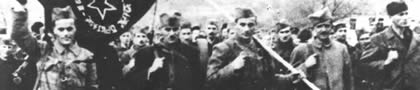
 The Yugoslav People's Army traces its roots to the National Liberation Struggle (NOB) and the Partisan Detachments of Yugoslavia. During World War II, on December 21, 1941, in the town of Rudo, the First Proletarian National Liberation Assault Brigade of the National Liberation Army of Yugoslavia (NOVJ) was founded as the first regular military formation of partisan units. At the end of World War II, on March 1, 1945, the NOVJ was renamed the Yugoslav Army (JA). The Yugoslav People's Army traces its roots to the National Liberation Struggle (NOB) and the Partisan Detachments of Yugoslavia. During World War II, on December 21, 1941, in the town of Rudo, the First Proletarian National Liberation Assault Brigade of the National Liberation Army of Yugoslavia (NOVJ) was founded as the first regular military formation of partisan units. At the end of World War II, on March 1, 1945, the NOVJ was renamed the Yugoslav Army (JA).  On the occasion of celebrating its tenth anniversary, on December 22, 1951, the Yugoslav Army was renamed the Yugoslav People's Army (Yugoslav People's Army), formally emphasizing its popular, socialist and revolutionary character. By some military assessments, the Yugoslav People's Army was the fourth or fifth military power in Europe. On the occasion of celebrating its tenth anniversary, on December 22, 1951, the Yugoslav Army was renamed the Yugoslav People's Army (Yugoslav People's Army), formally emphasizing its popular, socialist and revolutionary character. By some military assessments, the Yugoslav People's Army was the fourth or fifth military power in Europe.
With the fragmentation and later the dissolution of the SFRY, the Yugoslav People's Army lost its cohesive unity and was undermined from within. Born from the anti-fascist struggle and created by the nations and nationalities of Yugoslavia, it began to break apart with the secession of some Yugoslav republics (in 1991). It unhappily withdrew from the territories of Slovenia, Croatia and Bosnia-Herzegovina, and later from the territory of Macedonia. The national personnel balance shifted drastically and the Yugoslav People's Army, having lost the broader support of certain nations and nationalities of the former SFRY, was officially dissolved on May 20, 1992, with the proclamation of the Army of Yugoslavia as the armed force of the Federal Republic of Yugoslavia. |