
Samuel Morse |
|||
(1791-1872) |
|||
SAMUEL MORSE was born on April 27, 1791, in Charlestown near Boston, USA. He studied at Yale College. Less known is that Morse was an exceptional painter who left a great mark on the art of his era. He was also the first president of the National Academy of Design, but never succeeded in becoming a congressman or mayor of New York.
At the New York exhibition in 1838, he publicly exhibited his telegraph for the first time, along with a codebook where each number represented a different word. During the following years he refined his patent, although he was disappointed that the government and Congress were not providing sufficient support for his invention. Finally, in 1843, he received $30,000 from the government (about half a million dollars today) to commercialize his inventions. Finally, in 1844, he established the first wire telegraph between Washington and Baltimore. He sent the first telegraphic message on Friday, May 24, 1844. That message, transmitted in his code, was: "What Hath God Wrought."
After this, his patent was received with enthusiasm, so that by 1846 the lines became longer and Washington was connected to Buffalo and Boston. For his achievements he subsequently received numerous awards and decorations. He became a major donor to Yale College and other educational institutions. He died on April 2, 1872, from pneumonia. |
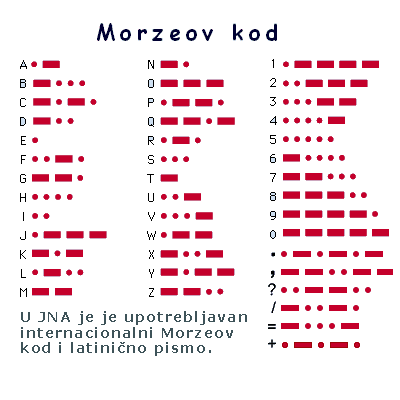 In 1832, upon returning from Europe, he learned about the newly discovered electromagnetism and the electromagnet, and later said
 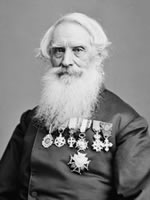 that the idea of an electric telegraph was born in his mind at that time. It is assumed that in 1835 he assembled the first telegraph from old parts, and in 1837 he filed his patent with the patent office.