
|
|||
Nikola Tesla |
|||
(1856-1943) |
|||
The Italian engineer Marconi (1874–1937) filed his patent for radio (No. 763772) on July 28, 1904. Before him, Nikola Tesla had filed his own patents for the same (Nos. 645576 and 649621) on September 2, 1897, which were even granted in 1900. Nevertheless, Marconi received the Nobel Prize in 1909, because in 1901 he was the first to send a radio signal across the Atlantic. The fact that it was based on the discoveries of Rudolf Hertz and Nikola Tesla was overlooked. Marconi's patent was overturned by the Supreme Court of the United States in June 1943 (Court Decision No. 6369), in favor of Nikola Tesla, who had already died (January 7, 1943).
Tesla was educated in Gospić, Karlovac, Graz and Prague, and in 1884 he moved to the USA where he achieved the greatest number of his inventions and approximately 700 patents.
In 1893, he devoted himself intensively to problems of radio technology, teleguiding and wireless transmission of energy over great distances without loss. In Colorado Springs He is also considered the "forefather" of modern weapons, such as cruise missiles, remotely guided vessels (the first of which he constructed in 1898), and even the American space weapons program "Star Wars." Guglielmo Marconi also copied his work, establishing the first radio-telegraphic link between Europe and America, but after a lengthy court process, the American court declared Marconi a plagiarist. Some scientists also believe that the invention of X-rays was unjustly attributed to Wilhelm Conrad Röntgen and not to Tesla. To make the absurdity greater, both Marconi and Röntgen received the Nobel Prize, which was never awarded to Tesla. He died on January 7, 1943, in New York. |
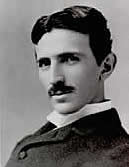 When asked who invented the radio, every student will give the answer found in most encyclopedias and school textbooks around the world: "Marconi." This answer is incorrect. The correct answer is "Nikola Tesla."
 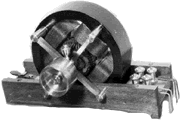 NIKOLA TESLA was born as the son of an Orthodox priest in the village of Smiljan near Gospić on July 10, 1856, and became renowned for his inventions, patents and improvements to electric motors, generators, transformers and for the application of alternating electric current. In recognition of the great scientist, the unit of magnetic field was named tesla (T) in 1956, and his name also appears among the distinguished individuals after whom mountains on the Moon are named.
 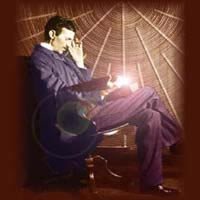 In America, he initially worked with Thomas Alva Edison, and in 1887 he established his own research center. Based on his alternating current patent (1888), the large hydroelectric plant at Niagara was built. Tesla was a visionary researcher in the study of charged particles, electromagnetic radiation and conductors, from which today's modern systems of radio communications, television, robotics and remote control have emerged.
 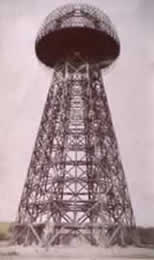 he successfully experimented with terrestrial stationary electromagnetic waves and wireless transmission. This planetary transmission of information and energy was to be based on the application of Tesla's inventions: resonant coreless transformers and a magnifying transmitter.