German telegraph key T-1 was part of war booty. It is made of black bakelite (a dark brown, almost black variant also exists). It is characterized by a very soft contact (by design, the lower contact plate is suspended in air and flexes under pressure, giving a special feel when keying). The keys have a series of markings on the  bakelite and metal base, indicating the factory, product type and year of manufacture. In addition, a white eagle marking with bakelite and metal base, indicating the factory, product type and year of manufacture. In addition, a white eagle marking with a swastika was placed on the left side in white. Operators (especially right after the war) were bothered by the Nazi markings and routinely scratched them off, or at least the swastika. The key is known locally as TAP, from the abbreviation found on the cover. Thanks to its quality, the key remained in use for a long time. a swastika was placed on the left side in white. Operators (especially right after the war) were bothered by the Nazi markings and routinely scratched them off, or at least the swastika. The key is known locally as TAP, from the abbreviation found on the cover. Thanks to its quality, the key remained in use for a long time.
 Unlike the T-1, the German mini key known as the "German mouse" is rarer in our region. Unlike the T-1, the German mini key known as the "German mouse" is rarer in our region.
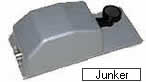
The Junker key was and remains one of the highest quality and most valued hand keys. It was produced in Germany before, during and after World War II, with minor changes . .
Telegraph key VR-150 is a domestic product, essentially a copy of the T-1 key. It is of quality manufacture, primarily from reddish-brown bakelite. Two variants exist: brown (all bakelite parts brown) and black (the lever has black bakelite coating). On the cover is a five-pointed star with the JA marking, and below it VR-150. This key was also highly regarded among operators.
 The domestic telegraph key TS-1, immediately after its adoption, became an integral part of the equipment set for stationary, transportable and portable radio stations. It is therefore manufactured with The domestic telegraph key TS-1, immediately after its adoption, became an integral part of the equipment set for stationary, transportable and portable radio stations. It is therefore manufactured with two bases: one standard for use on a stable work surface, and another with straps for attachment to the leg. It is of robust construction and quality manufacture. The base and cover are metal, green in color. The key body and knob are made of black bakelite, and the lever is chrome or nickel-plated. two bases: one standard for use on a stable work surface, and another with straps for attachment to the leg. It is of robust construction and quality manufacture. The base and cover are metal, green in color. The key body and knob are made of black bakelite, and the lever is chrome or nickel-plated.
This key served as the basis for various modified versions, used especially in Morse code training classrooms (TS-1 school, RTG01 and similar).
 Telegraph key TS-3 is designed for training and conditioning radio-telegraph operators, and features a built-in tone oscillator. It can also be used for Morse telegraphy on a direct line, network and circular mode, connected via the MP-10 induction exchange, or directly to HF devices (unmodulated telegraphy) and VHF devices (modulated telegraphy). The operating mode was selected by a combination of two switch positions. Modified versions were also produced for various Morse code training classrooms (e.g. TS-3 Vihor). Power supply: two R-6 (AA) batteries Telegraph key TS-3 is designed for training and conditioning radio-telegraph operators, and features a built-in tone oscillator. It can also be used for Morse telegraphy on a direct line, network and circular mode, connected via the MP-10 induction exchange, or directly to HF devices (unmodulated telegraphy) and VHF devices (modulated telegraphy). The operating mode was selected by a combination of two switch positions. Modified versions were also produced for various Morse code training classrooms (e.g. TS-3 Vihor). Power supply: two R-6 (AA) batteries . .
Telegraph key TS-4 is also designed primarily for training and conditioning, but also for operational use. It replaced the TS-3. It is compact, with a built-in tone oscillator. Used independently or as part of stationary and portable Morse code training sets. Better quality than TS-3, with better adjustment and a better tone oscillator, it was quickly accepted by radio-telegraph operators. Power supply: two R-6 (AA) batteries . .
 In the equipment sets of various spy radio stations and briefcase radios, miniature keys were included. For example, the British Type 3 Mk II radio device came with the mini B-2 key, and with the BP-5 device came a miniature key, which was also built into the top panel of the AP-5 spy radio station. In the equipment sets of various spy radio stations and briefcase radios, miniature keys were included. For example, the British Type 3 Mk II radio device came with the mini B-2 key, and with the BP-5 device came a miniature key, which was also built into the top panel of the AP-5 spy radio station.
With devices procured from the Soviet Union, various keys came along, most commonly themilitary, school and KM  (also known as TK), or KM-F (TK-F). The letter F indicates that the keys had built-in HF filters in the base (also known as TK), or KM-F (TK-F). The letter F indicates that the keys had built-in HF filters in the base . .
American devices were delivered with various keys, most commonly J-37 (on a standard base, or as KY116/U on a metal leg holder), J-48 (most often in an ugly tin enclosure) various variants of the Signal Electric serije R and others.
 Imported Collins PRC-515 and domestic RU-20 radio stations came with KY-5033 keys in their sets. They differed in that the imported KY-5033 (PRC-515) had embossed markings, while the domestic KY-5033 (RU-20) had white painted markings. Due to poor adjustment, the key was not highly regarded among radio-telegraph operators and was usually replaced with the TS-1. Imported Collins PRC-515 and domestic RU-20 radio stations came with KY-5033 keys in their sets. They differed in that the imported KY-5033 (PRC-515) had embossed markings, while the domestic KY-5033 (RU-20) had white painted markings. Due to poor adjustment, the key was not highly regarded among radio-telegraph operators and was usually replaced with the TS-1.
With Racal radio stations, larger keys manufactured by MORSE EQUIPMENT LTD were supplied for stationary devices, and Racal mini keys for portable devices (primarily the TRA-931). The number on the top is the NATO nomenclature number for the key, and the number 99 indicates Great Britain. |







 technical manuals).

 Telegraph key TS-3


