| |
| The first communications devices used for military purposes were telephone-telegraph devices. It is hard to imagine commanding armies of millions in World War I without the use of the telegraph and telephone. Also, the first communications devices produced in domestic factories after World War II were the induction telephone exchange MP-10 and the field telephone PTI-49, which belong to this category.
Wire communications in the Yugoslav People's Army formed the backbone of the communications system, and radio and radio-relay communications relied on them. They were divided into stationary and mobile. Stationary wire communications used commercial technical solutions and followed the development of "civilian telephony". They were highly integrated into the state telecommunications system of the former Yugoslavia. Mobile wire communications served for communications between units and commands in the field, as well as to successfully replace parts of the stationary system damaged and destroyed by enemy combat actions. |
| |
Tabular overview of telephone-telegraph devices |
(clicking on the device code allows you to navigate quickly within the page) |
| |
DESIGNATION
|
DEVICE DESCRIPTION
|
ORIGIN
|
| |
|
* Morse telegraph device |
Yugoslavia |
| |
|
* Field induction telephone set |
Yugoslavia |
| |
|
* Field induction telephone set |
Yugoslavia |
| |
|
* Field induction telephone set |
USA |
| |
|
* Field induction telephone set |
SSSR (Russia) |
| |
|
* Field induction telephone exchange |
Yugoslavia |
| |
SB-22/PT |
* Field induction telephone exchange |
USA |
| |
ITC-10 |
* Field induction telephone exchange |
Yugoslavia |
| |
|
* Induktorska telefonska centrala |
Yugoslavia |
| |
|
* RFT page teleprinter |
East Germany |
| |
|
* Siemens tape teleprinter |
West Germany |
| |
|
* Siemens page teleprinter |
West Germany |
| |
|
* EI Niš electronic tape teleprinter |
Yugoslavia |
| |
|
* EI Niš electronic page teleprinter |
Yugoslavia |
| |
|
* Telegraph modem (1225Hz–1325Hz) |
Yugoslavia |
| |
|
* Telegraph modem (1125Hz–1425Hz) |
Yugoslavia |
| |
|
* Radio-teleprinter system control device |
Yugoslavia |
| |
FNT-5 |
* Multi-channel telephone device |
Yugoslavia |
|
| |
Description of telephone-telegraph devices |
 |
 MA-1 Morse telegraph device MA-1 Morse telegraph device
A device produced by "Industrija precizne mehanike Belgrade" in 1945. It was designed for transmitting and receiving messages by Morse telegraphy over wire lines. Reception was performed on paper tape driven by electronics using vacuum tubes. Origin: Yugoslavia. |
|
 |
| M-63 Field induction telephone set
 Every soldier, and especially signals personnel and radio operators, had to encounter this telephone. It was produced by the Slovenian company "Iskra" in the early 1960s. The American TA-314 series of field military telephones served as their model. Every soldier, and especially signals personnel and radio operators, had to encounter this telephone. It was produced by the Slovenian company "Iskra" in the early 1960s. The American TA-314 series of field military telephones served as their model.
 It was primarily designed for maintaining telephone communications over field wire lines at distances of up to 30 km. It could be connected, via an appropriate junction box, to manual telephone exchanges of the LB (local battery) and CB (central battery) systems. With the additional dial BN-1, it could be connected to an automatic telephone exchange. A particularly interesting mode of operation was remote control of a radio device over the field wire line PTK-56 at distances of up to 10 km. The calling voltage was obtained by turning the inductor handle and was up to 115V/25Hz AC, while the microphone was powered by two R-20 batteries (3V). Origin: Yugoslavia. It was primarily designed for maintaining telephone communications over field wire lines at distances of up to 30 km. It could be connected, via an appropriate junction box, to manual telephone exchanges of the LB (local battery) and CB (central battery) systems. With the additional dial BN-1, it could be connected to an automatic telephone exchange. A particularly interesting mode of operation was remote control of a radio device over the field wire line PTK-56 at distances of up to 10 km. The calling voltage was obtained by turning the inductor handle and was up to 115V/25Hz AC, while the microphone was powered by two R-20 batteries (3V). Origin: Yugoslavia.
|
|
|
|
 PTI-49 Field induction telephone set PTI-49 Field induction telephone set
The PTI-49 induction telephone set is a product of the domestic military industry from 1949. It was used for maintaining telephone communications in all units of the JA and JNA over field lines at distances of up to 40 km. It was connected to LB (local battery) system telephone exchanges. Its housing was made of hard bakelite. It was powered by 1.5V from an R-20 battery. In the mid-1960s it was phased out of service and replaced by the more modern telephone set M-63. Origin: Yugoslavia. |
|
|
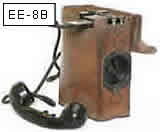 Field induction telephone set EE-8B Field induction telephone set EE-8B
The EE-8B field telephone was produced in 1944 and the American Army was equipped with it. The Yugoslav Army received the EE-8B telephone as part of American military aid in 1949. It was designed for maintaining telephone communications over field wire lines at distances of up to 30 km. It belongs to the group of LB (local battery) system field telephones. It was powered by two batteries at 3V.
The American Army last used this telephone in the Vietnam War, and the JNA phased it out in the 1960s, replacing it with the M-63. Origin: USA. |
|
| |
Field induction telephone setTA-57
 The TA-57 field telephone set was manufactured in the Soviet Union in the mid-1950s. When purchasing medium and high-power radio systems from the Soviet Union in the early 1960s, the Yugoslav People's Army also imported this telephone as it was included in their sets. The TA-57 served for maintaining telephone communications in field conditions at distances of up to 40 km. It could be connected to LB and CB system telephone exchanges. It could also be used to remotely control a radio device over a dual-wire field line. It was most commonly found in imported Russian systems. It was powered by 1.5V from an R-20 battery. Origin: USSR (Russia). The TA-57 field telephone set was manufactured in the Soviet Union in the mid-1950s. When purchasing medium and high-power radio systems from the Soviet Union in the early 1960s, the Yugoslav People's Army also imported this telephone as it was included in their sets. The TA-57 served for maintaining telephone communications in field conditions at distances of up to 40 km. It could be connected to LB and CB system telephone exchanges. It could also be used to remotely control a radio device over a dual-wire field line. It was most commonly found in imported Russian systems. It was powered by 1.5V from an R-20 battery. Origin: USSR (Russia).
|
|
|
|
Induction Telephone Exchange MP-10
 The MP-10 is one of the first domestic devices produced immediately after World War II. It was designed for manual switching of field telephone communications. Up to 10 lines could be connected, with 5 simultaneous conversations. For receiving the induction call signal and announcing call completion, the MP-10 had indicators, and a DC bell was connected for audible signaling. The housing was made of wood, and a distinctive feature was that it had no integrated operator telephone — a PTI-49 or M-63 was connected externally. Radio operators typically encountered it as part of the small command staff vehicle set (MKŠK — the battalion commander's communications vehicle). Origin: Yugoslavia. The MP-10 is one of the first domestic devices produced immediately after World War II. It was designed for manual switching of field telephone communications. Up to 10 lines could be connected, with 5 simultaneous conversations. For receiving the induction call signal and announcing call completion, the MP-10 had indicators, and a DC bell was connected for audible signaling. The housing was made of wood, and a distinctive feature was that it had no integrated operator telephone — a PTI-49 or M-63 was connected externally. Radio operators typically encountered it as part of the small command staff vehicle set (MKŠK — the battalion commander's communications vehicle). Origin: Yugoslavia.
|
|
|
|
Induction Telephone Exchange SB-22/PT
The SB-22/PT portable induction exchange was produced in the USA in the late 1940s, and "Signal Corps" units of the American army were equipped with it, where it served as one of the basic LB system telephone exchanges at the tactical level. The Yugoslav Army received this exchange from the USA as military aid and incorporated it into the communications units' inventory  around 1950. around 1950.
The exchange was used for manual switching of up to 12 LB (local battery) system telephone subscribers. Call indication was both audible and mechanical, and subscriber calling was accomplished by an inductor at AC voltage 90-100V/20Hz. The operator headset microphone was powered by two 1.5V batteries, and two additional batteries were used for front panel lighting. Origin: USA. |
|
|
|
Induction Telephone Exchange ITC-10
 A more modern domestic solution for an induction telephone exchange with the same purpose as MP-10 — manual switching of field telephone communications. The capacity is also the same — 10 lines. The ability to connect to an automatic telephone exchange (ATC) and switch LB subscriber lines to the ATC was added. The housing of this exchange was made of dural aluminum and, when the front cover was installed, it was hermetically protected from water. The operator telephone, bell, inductor, and dial were integral parts of the exchange. Only the handset was connected externally. Radio operators most often encountered it as operators of the MKŠK (Small Command Staff Vehicle). Origin: Yugoslavia. A more modern domestic solution for an induction telephone exchange with the same purpose as MP-10 — manual switching of field telephone communications. The capacity is also the same — 10 lines. The ability to connect to an automatic telephone exchange (ATC) and switch LB subscriber lines to the ATC was added. The housing of this exchange was made of dural aluminum and, when the front cover was installed, it was hermetically protected from water. The operator telephone, bell, inductor, and dial were integral parts of the exchange. Only the handset was connected externally. Radio operators most often encountered it as operators of the MKŠK (Small Command Staff Vehicle). Origin: Yugoslavia.
|
|
|
|
Induction Telephone Exchange TlCi-10
 The TlCi-10 induction telephone exchange was produced and entered JNA service in 1980. It is designed for manual switching of up to 10 subscribers (8 field telephone lines and 2 connections from an automatic telephone exchange). The TlCi-10 induction telephone exchange was produced and entered JNA service in 1980. It is designed for manual switching of up to 10 subscribers (8 field telephone lines and 2 connections from an automatic telephone exchange).
 When connecting subscribers, compared to the older solutions MP-10 and ITC-10, sliders are used here. Working with sliders was faster and they wore out less than patch cables. The exchange has an integrated telephone and dial, and an operator's telephone can be connected if needed. Operation indication was via LED indicators, and calling was done by a manual inductor. It was battery-powered — DC voltage of 6V (4 R-20 batteries at 1.5V). The housing of this exchange was also made of aluminum and was hermetically sealed with covers, providing water protection. Origin: Yugoslavia. When connecting subscribers, compared to the older solutions MP-10 and ITC-10, sliders are used here. Working with sliders was faster and they wore out less than patch cables. The exchange has an integrated telephone and dial, and an operator's telephone can be connected if needed. Operation indication was via LED indicators, and calling was done by a manual inductor. It was battery-powered — DC voltage of 6V (4 R-20 batteries at 1.5V). The housing of this exchange was also made of aluminum and was hermetically sealed with covers, providing water protection. Origin: Yugoslavia.
|
|
|
RFT page teleprinter RFT-51-D2
 This teleprinter was produced at the RFT factory in East Germany in the 1950s. It operated at a speed of 50 baud and used wide teleprinter paper tape. It was purchased for use as a school teleprinter and equipped some classrooms for training teleprinter and radio-teleprinter operators. It was characterized by a very simple construction, but had a fairly precise keyboard. It could be found in some JNA communications units right up to the end of 1991. This teleprinter was produced at the RFT factory in East Germany in the 1950s. It operated at a speed of 50 baud and used wide teleprinter paper tape. It was purchased for use as a school teleprinter and equipped some classrooms for training teleprinter and radio-teleprinter operators. It was characterized by a very simple construction, but had a fairly precise keyboard. It could be found in some JNA communications units right up to the end of 1991.
Origin: East Germany.
|
|
|
 Siemens tape teleprinter T-68d Siemens tape teleprinter T-68d
This was a tape-printing teleprinter, which was its major drawback because reading messages from 5-6 meter long paper tapes was impractical. It was installed in the first units of the domestic RTU-100 radio-teleprinter system, but was soon replaced due to the aforementioned shortcoming, and also because of errors and jamming at low temperatures during field operations. Later, it was used for typing practice in some units. It was produced in 1936, and entered service with the JA in 1945. Origin: Germany. |
|
|
| Siemens page teleprinter T-100
  This Siemens teleprinter was popular among radio-teleprinter operators, due to its compactness (power supply was integrated into the teleprinter itself), very high quality construction, and precise keyboard (a true representative of the famous German craftsmanship). It could be set to speeds of 50, 75, and 100 Baud. It was installed in domestic radio-teleprinter systems and was a fixture in stationary communications centers. Origin: Germany. This Siemens teleprinter was popular among radio-teleprinter operators, due to its compactness (power supply was integrated into the teleprinter itself), very high quality construction, and precise keyboard (a true representative of the famous German craftsmanship). It could be set to speeds of 50, 75, and 100 Baud. It was installed in domestic radio-teleprinter systems and was a fixture in stationary communications centers. Origin: Germany.
|
|
|
|
EI Niš Electronic tape teleprinter ET-1
 The teleprinter with which "Elektronska industrija" from Niš entered the production of "electronic" teleprinters in 1972. German designs served as the model for the engineers, but some mechanical assemblies were replaced with more modern electronic ones, which is how it got the name "electronic". Its major drawback was that it printed on narrow paper tape, and it was produced at a time when this solution was already quite obsolete, so it did not remain in use for long, being replaced by the more modern teleprinter ETL-1. It could be set to speeds of 50 and 75 Baud. It was powered by AC voltage 220/110V. It was incorporated into the domestic RTU-100 radio-teleprinter system in the early stages of its production. Origin: Yugoslavia. The teleprinter with which "Elektronska industrija" from Niš entered the production of "electronic" teleprinters in 1972. German designs served as the model for the engineers, but some mechanical assemblies were replaced with more modern electronic ones, which is how it got the name "electronic". Its major drawback was that it printed on narrow paper tape, and it was produced at a time when this solution was already quite obsolete, so it did not remain in use for long, being replaced by the more modern teleprinter ETL-1. It could be set to speeds of 50 and 75 Baud. It was powered by AC voltage 220/110V. It was incorporated into the domestic RTU-100 radio-teleprinter system in the early stages of its production. Origin: Yugoslavia.
|
|
|
 EI Niš Electronic page teleprinter ETL-1 EI Niš Electronic page teleprinter ETL-1
A product of domestic industry (Elektronska industrija - Niš), produced in large quantities, it became the standard teleprinter in the mobile communications system in 1981. It represented a compact solution with a housing made of robust plastic. Its telegraphy speeds were 50, 75, and 100 Baud (the JNA operated at 50 Baud). Radio-teleprinter operators considered its keyboard less precise and sensitive compared to the Siemens T-100. Origin: Yugoslavia. |
|
|
|
TG-1 Telegraph modem (1225Hz–1325Hz)
The TG-1 telegraphic modem was primarily designed to enable teleprinter telegraphy over two-wire or four-wire lines, either directly between two teleprinters or indirectly via telephone or telegraph exchanges, at speeds up to 75 baud. The teleprinter was connected to it, and it provided the 40 mA line current  required for its operation. Its operating principle is based on the FSK (Frequency Shift Keying) method, converting the DC pulses of the teleprinter into two tones: the marking (no-current) pulse at 1225 Hz and the spacing (current) pulse at 1325 Hz. The frequency shift is 100 Hz. required for its operation. Its operating principle is based on the FSK (Frequency Shift Keying) method, converting the DC pulses of the teleprinter into two tones: the marking (no-current) pulse at 1225 Hz and the spacing (current) pulse at 1325 Hz. The frequency shift is 100 Hz.
Radio operators frequently used this device because it was located together with the teleprinter at a remote or detached location, and through it, message transmission and radio-teleprinter modem control were carried out, until the introduction of the Radio-Teleprinter System Control Device UP-1.
It was built using transistor technology and was produced by "Elektronska industrija" from Niš in the late 1960s. It was powered by AC voltage 220/110V or DC voltage 12V. Its housing was made of aluminum and could be hermetically sealed with the front cover during transport. Origin: Yugoslavia. |
|
|
| TG-2 Telegraph modem (1125Hz–1425Hz)
The TG-2 telegraphic modem was produced by "Elektronska industrija" from Niš in 1963. It was located directly alongside the radio-teleprinter modem, and its primary purpose was to convert the current and no-current pulses of the teleprinter into a signal suitable for transmission via a radio device and to provide line current for the teleprinter. The TG-2 converted these signals  into two tones at frequencies 1125 Hz and 1425 Hz (shift 300 Hz) and enabled operating speeds up to 75 Baud. It was built entirely using transistor technology. into two tones at frequencies 1125 Hz and 1425 Hz (shift 300 Hz) and enabled operating speeds up to 75 Baud. It was built entirely using transistor technology.
Its secondary purpose was to enable remote control when connected by a line directly or via a telephone or telegraph exchange to a detached or remote location (usually at a receiving radio center from which telegram and message transmission was carried out). For this it had to be paired with the Telegraphic Modem TG-1 and the Telephone-Telegraph Filter FL-1, which were also part of the RTp system. It was powered by AC voltage 220/110V or DC voltage 12V from the system's common accumulator. Its housing was made of aluminum, and externally, when closed with the cover, it differed from the TG-1 only by its markings. Origin: Yugoslavia. |
|
|
Radio-Teleprinter System Control Device UP-1
The UP-1 device was also produced by "Elektronska industrija" from Niš around 1982. As its name suggests, it was used for controlling the radio-teleprinter modem either directly at the device or remotely (from a detached or distant  location) via a two-wire line or telephone channel. It also provided an official telephone connection between the RTp device operator and the operator at the remote location over the same line. It combined three telegraphic devices previously used for this purpose: the telegraphic modem TG-2, the telegraphic modem TG-1, and the filter FL-1). location) via a two-wire line or telephone channel. It also provided an official telephone connection between the RTp device operator and the operator at the remote location over the same line. It combined three telegraphic devices previously used for this purpose: the telegraphic modem TG-2, the telegraphic modem TG-1, and the filter FL-1).
 Remote control was exercised for all operating modes: unmodulated telegraphy (CW), telephony (SSB and AM), and teleprinter telegraphy (RTTY). It supplied the connected teleprinter with a line current of 40 mA. It was line-compatible with the TG-1 (marking/no-current pulse frequency 1225 Hz, spacing/current pulse 1325 Hz, shift 100 Hz), and radio-modem compatible with the TG-2 (no-current pulse 1125 Hz, current pulse 1425 Hz, shift 300 Hz). The teleprinter telegraphy speed was up to 75 baud. It was powered by AC voltage 220/110V or DC voltage 12V from the system's common accumulator. Its housing is identical to the telegraphic modems TG-1 and TG-2. Origin: Yugoslavia. Remote control was exercised for all operating modes: unmodulated telegraphy (CW), telephony (SSB and AM), and teleprinter telegraphy (RTTY). It supplied the connected teleprinter with a line current of 40 mA. It was line-compatible with the TG-1 (marking/no-current pulse frequency 1225 Hz, spacing/current pulse 1325 Hz, shift 100 Hz), and radio-modem compatible with the TG-2 (no-current pulse 1125 Hz, current pulse 1425 Hz, shift 300 Hz). The teleprinter telegraphy speed was up to 75 baud. It was powered by AC voltage 220/110V or DC voltage 12V from the system's common accumulator. Its housing is identical to the telegraphic modems TG-1 and TG-2. Origin: Yugoslavia.
|
|
|
Multi-Channel Telephone Device FNT-5
 The FNT-5 multi-channel telephone device is one of the first domestic carrier-frequency devices, produced by the Slovenian "Iskra" in 1959. It was designed for simultaneous transmission of up to 4 telephone channels over a 2-wire or 4-wire line. Using a telegraph filter, teleprinter telegraphy could also be carried out over these telephone channels. The FNT-5 multi-channel telephone device is one of the first domestic carrier-frequency devices, produced by the Slovenian "Iskra" in 1959. It was designed for simultaneous transmission of up to 4 telephone channels over a 2-wire or 4-wire line. Using a telegraph filter, teleprinter telegraphy could also be carried out over these telephone channels.
 The device consisted of 4 physically separate modules (so-called channels) housed in aluminum enclosures. The modules are stacked on top of each other during operation and fastened together with clasps. The telephone channels are frequency multiplexed in the range from 3.7 kHz to 29.3 kHz (3.7–9.5 kHz: channel I, 10.3–16.1 kHz: channel II, 16.9–22.7 kHz: channel III, 23.5–29.3 kHz: channel IV). Classic LC filters were used for mutual frequency separation of the telephone channels, and the device was built using vacuum tube technology. It was powered by AC voltage of 220V. The device consisted of 4 physically separate modules (so-called channels) housed in aluminum enclosures. The modules are stacked on top of each other during operation and fastened together with clasps. The telephone channels are frequency multiplexed in the range from 3.7 kHz to 29.3 kHz (3.7–9.5 kHz: channel I, 10.3–16.1 kHz: channel II, 16.9–22.7 kHz: channel III, 23.5–29.3 kHz: channel IV). Classic LC filters were used for mutual frequency separation of the telephone channels, and the device was built using vacuum tube technology. It was powered by AC voltage of 220V.
Origin: Yugoslavia.
|
|
|